地下室装修入门:从防水到饰面
地下室是 GTA 最被低估的空间。如何改造您的地下室,以及区分一次到位的装修与表面翻新的四件事。
ℹ️ 本文章正文目前仅有英文版本。我们正在逐篇准备完整的中文翻译 —— 如有疑问,欢迎通过联系页面与我们沟通。
Basements are where we see the biggest gap between what a renovation looks like and what it actually is. Paint the walls, drop a ceiling, lay a floor, done — right? Not quite. A proper basement renovation in the GTA is the sum of four serious systems done well. Skip any of them and you'll be ripping it out in five years.
1. Waterproofing — the foundation of everything else
Most GTA homes built before 1985 have at least some water issue in the basement, even if it looks dry today. Clay soils, seasonal freeze-thaw, aging weeping tiles, and cracked parging all contribute. Before any drywall goes up, we assess:
- Is the existing waterproofing membrane intact? (Interior and exterior.)
- Are weeping tiles functional, and do they drain to a working sump pump?
- Are there visible cracks in the foundation wall — and if so, hairline or structural?
- Is there evidence of historic water infiltration (efflorescence, staining, musty odour)?
If waterproofing needs work, do it before finishing. Interior waterproofing with a dimpled membrane and new weeping tile runs $12K–$25K. Exterior waterproofing is 2–3x that but handles the problem at its source. Finishing over a compromised basement is the single biggest money-waster in renovation.
2. Moisture and vapour control
Even in a bone-dry basement, concrete walls transmit vapour. A finished basement needs:
- A proper vapour barrier between the concrete and the new framing
- Continuous rigid foam insulation on walls (we use 2" XPS minimum in the GTA)
- Sealed penetrations around windows, plumbing, and floor joists
The 2024 Ontario Building Code updates tightened basement insulation requirements significantly. Older insulation specs no longer pass, so expect this to be part of any permitted basement job going forward.
3. Structural & layout decisions
Once the envelope is sound, you can think about how you actually want to use the space. A few considerations most homeowners underestimate:
- Ceiling height. GTA bungalows and semi-detacheds often have 7'6" or less. Dropping 10" for ducts, electrical, and ceiling finish leaves you with 6'8" — legal but cramped. Sometimes lowering the floor (underpinning) is worth it. Typically $40K–$90K depending on square footage.
- Egress windows. Any bedroom in a basement needs a proper egress window. Adding one is a $6K–$12K job including cutting through the foundation.
- Secondary suite potential. Even if you don't plan to rent, designing with code-compliant secondary-suite separation (fire rating, egress, separate HVAC) keeps options open.
4. The finishes — where the room becomes a room
Now we're into the fun part. A few GTA-specific recommendations we've landed on after a decade of basement work:
- Flooring: luxury vinyl plank (LVP) or engineered hardwood over a subfloor — never real hardwood directly on slab. Polished concrete is beautiful but reads very cold in Canadian winters.
- Lighting: recessed pot lights in a proper pattern (not a grid), warm-white (2700K–3000K), on dimmers. Basements need more lumens than you'd think — aim for 40+ lumens per square foot.
- Ceilings: drywall beats drop-ceiling in almost every case. Access panels where you truly need them; drywall everywhere else.
- HVAC: supplementary zone control or mini-split — basements heat and cool differently than the rest of the house.
Typical GTA basement renovation budget
For planning purposes in 2026:
- Cosmetic refresh (paint, floor, lighting): $25K–$50K
- Full finish from unfinished basement: $85K–$180K
- Finish + waterproofing + underpinning + secondary suite: $200K–$400K+
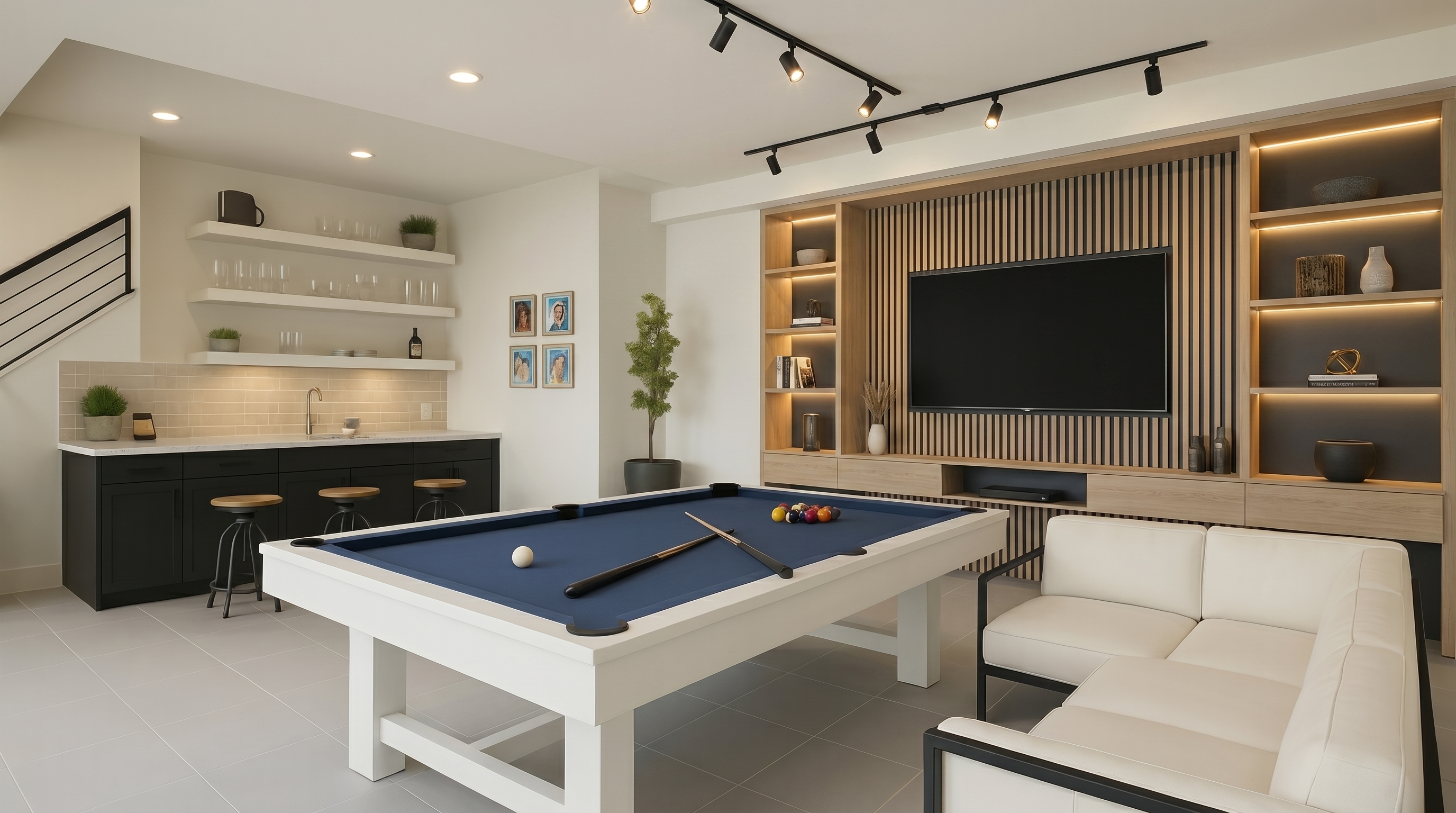
The ROI on a well-done basement finish is real — we typically see 50–75% recovered at resale in the GTA, and the usable square footage it adds to daily life is immense. Just make sure you're paying for all four layers — not just the pretty one on top. If you want to see what finished basements look like in GTA homes, browse our recent basement and whole-home projects.
Basement renovation FAQs
How much does a basement renovation cost in the GTA?
A cosmetic refresh (paint, flooring, lighting) runs $25,000–$50,000 in the GTA. A full finish from an unfinished basement typically costs $85,000–$180,000. Adding waterproofing, underpinning, and a secondary suite can push the total to $200,000–$400,000+.
Do I need a permit to finish my basement in Ontario?
Yes. Framing new walls, running electrical circuits, adding plumbing fixtures, and installing egress windows all require a building permit in Toronto, Markham, Vaughan, Richmond Hill, and the rest of the GTA. The 2024 Ontario Building Code updates also tightened insulation requirements for finished basements.
How do I know if my basement needs waterproofing before finishing?
Look for efflorescence (white powdery deposits on concrete), staining on walls, a musty odour, visible cracks in the foundation wall, or evidence of historic water infiltration. If any are present, interior waterproofing ($12,000–$25,000) or exterior waterproofing (2–3x that) should be done before any drywall goes up.
Is underpinning worth it to raise my basement ceiling?
If your existing ceiling height is under 7'6" — common in GTA bungalows and semi-detached homes — underpinning to lower the floor is often worth it. Budget $40,000–$90,000 depending on square footage. The difference between a 6'8" and 7'4" finished ceiling transforms how the space feels and how it's used.
准备开始您的装修?
Grand Craft Renovations specializes in custom renovations across Toronto, Richmond Hill, Markham, Vaughan, and the GTA. See our 住宅翻新与整体改造 services or request a free consultation — no obligation.